About the Model
PCRDM offers a way to understand the changing relationship between parent and child. It proposes that strain can arise when familiar ways of relating no longer fit the people we are becoming.
Child and Parent Development
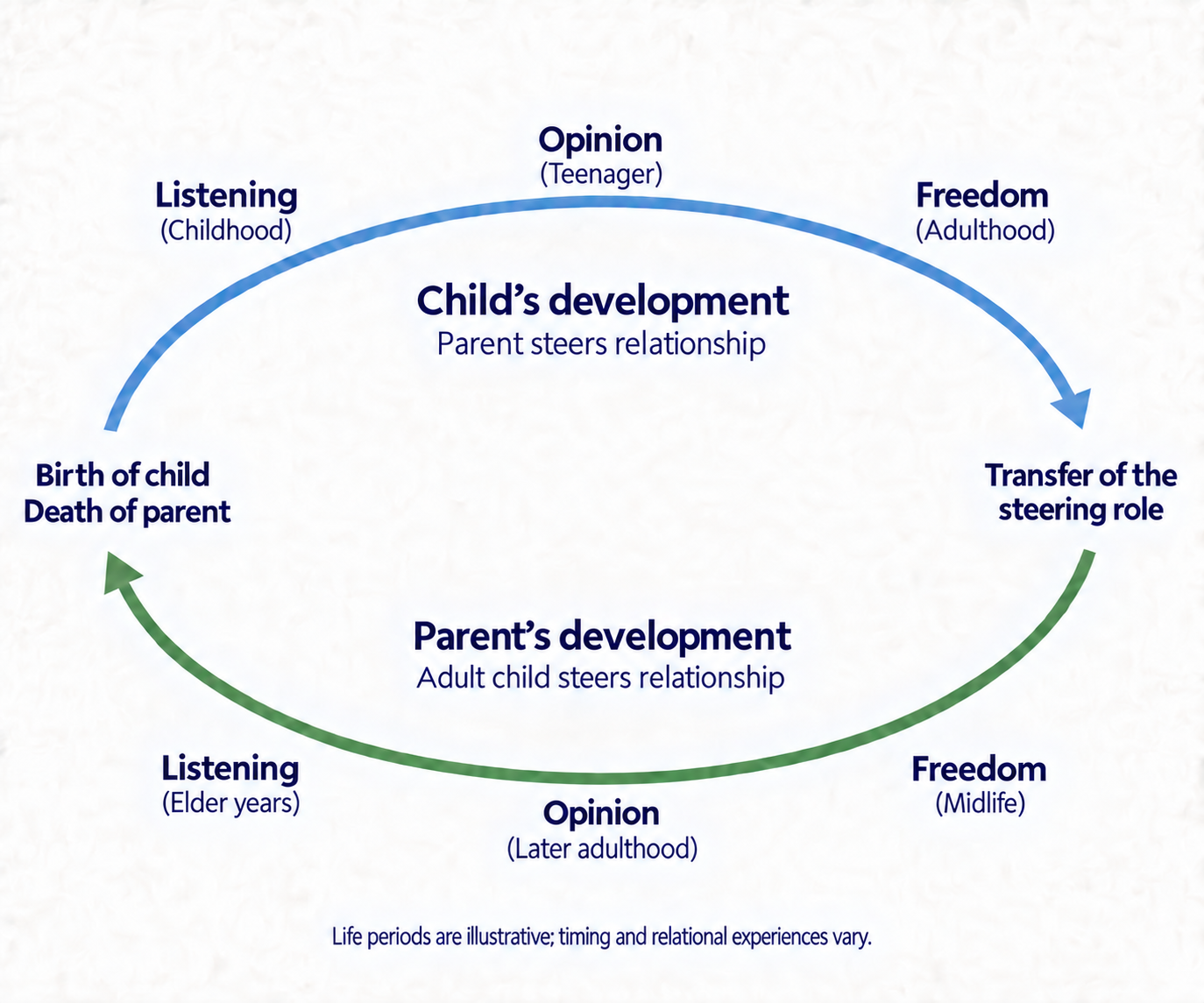
The upper arc follows the child’s development into adulthood, with the parent initially steering the relationship. The lower arc follows the parent’s development as the adult child takes a greater steering role.
The life periods are illustrative; timing and relational experiences vary. The child’s stages progress from Listening to Opinion to Freedom; the parent’s stages follow the reverse sequence, from Freedom to Opinion to Listening. Healthy ways of communicating can carry forward through each stage.
The Three Stages
Listening
Receiving guidance and support, first as a child and later as a parent whose needs change as they age.
Opinion
Expressing your own views and wanting them to be heard, even when parent and child see things differently.
Freedom
Adjusting to greater independence within the relationship—as a child takes more responsibility for their own life, or a parent’s day-to-day parenting responsibilities lessen.
Insight, Empathy, and Relational Growth
Insight and empathy support healthier progression through the stages and greater relational fluidity, deepening awareness and understanding. When one person engages in this process, they may gain insight into themselves, their past, and the relationship. When both people participate, they create greater opportunities for shared growth and may develop greater appreciation of one another and their relationship.
An Example: Freedom
A young adult leaves home and gains independence. Their parent adjusts to fewer day-to-day parenting responsibilities. Both experience Freedom, but in different ways.
What does this bring up for you?
The planned free PCRDM survey will invite you to reflect on changing roles and expectations in your own parent-child relationship.
The guidebook will take you further into the model, with fuller explanations, everyday examples, and guided reflection on how relationships respond to change.
Both are in development. Learn about the survey and guidebook.
PCRDM is an evolving, clinically informed framework used for education and therapeutic dialogue. This introduction does not assess or diagnose a relationship.